
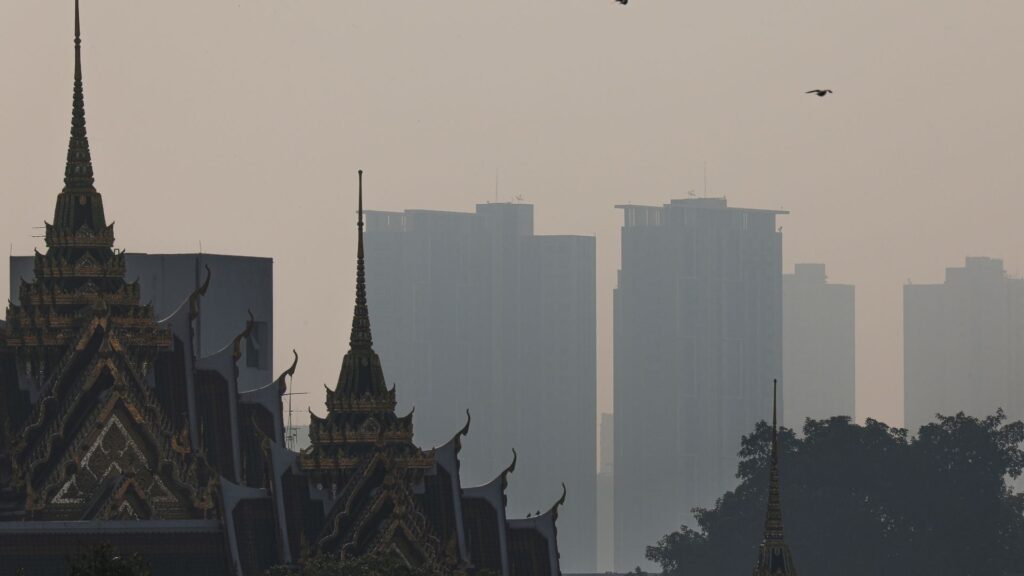
Image credit: https://world.thaipbs.or.th/detail/56230
At certain times of the year, outdoor air quality in Bangkok can be poor due to fine air pollution (PM2.5). These very small particles can affect breathing, particularly during outdoor activity. This guidance explains when masks are helpful, which types are effective, and when they are not needed at school.
When Masks are Helpful
Masks are recommended outdoors when air quality reaches Unhealthy levels or above, as outlined in the school’s Air Quality Policy. Their purpose is to reduce the amount of polluted air breathed in when students need to be outside.
Masks are most useful during short outdoor movements or low-intensity activity. They are not a replacement for reducing outdoor activity when air quality is poor.
Choosing the Right Mask
Only certain masks are effective at filtering PM2.5. Parents should choose masks labelled N95, KN95, or KF94, as these are designed to filter very small particles when they fit well.
Cloth masks, fashion masks, and standard surgical masks do not provide reliable protection against air pollution. These masks are loose-fitting and mainly block larger droplets, not fine pollution particles.
When buying masks, parents are encouraged to use trusted retailers and to check that the mask clearly shows its certification. Younger students should use child-sized masks so that the mask fits properly.
Wearing Masks Properly
For a mask to work, it must fit well. It should cover both the nose and mouth, sit close to the face, and have no large gaps at the sides. The nose strip should be pressed firmly so the mask stays in place when talking or moving gently.
Students should wash or sanitise their hands before putting a mask on and after taking it off. Masks should be removed using the straps rather than the front and replaced if they become wet, damaged, or dirty.
Masks should be worn only when needed, mainly outdoors during periods of poor air quality.
Mask Use Indoors and in Classrooms
All enclosed learning spaces at school are fitted with filtered fresh-air systems, and indoor air quality is monitored throughout the day. This means classroom air remains clean and safe even when outdoor pollution levels are high.
For this reason, masks are not required indoors for air-quality protection. Students may safely remove masks in classrooms and other enclosed learning spaces. We encourage this as it supports comfort, clear communication, and effective teaching and learning. Being able to see faces and hear speech clearly helps discussion, collaboration, and student wellbeing.
Families who prefer their child to continue wearing a mask indoors may do so, but it is not necessary for protection from air pollution in these environments.
Comfort and Well-being
Well-fitted masks can feel warm and humid when worn for long periods. This is normal and not harmful, but it can affect comfort and concentration. Because classroom air is already filtered and well controlled, mask use is best focused on outdoor exposure when air quality is poor.
Supporting Individual Needs
Students with asthma or other respiratory conditions should have their medical information updated with the school and follow advice from their healthcare provider. The school will continue to make adjustments to activities and provide individual support when needed.
Key Message
Masks can help reduce exposure to air pollution outdoors when air quality is poor. Inside school buildings, where air is filtered and monitored, masks are not needed and can be removed to support comfort, communication, and learning.