
The spotlight is blinding. The applause is deafening. In your hands, a massive golden trophy gleams under the lights while you and your team stand on stage, realizing what you have just accomplished: out of more than 1000 scholars from around the world, you are the champions, the best of the best.
And this isn’t just a simple-minded fantasy. This could very well be your reality if you join Patana’s World Scholar’s Cup programme.
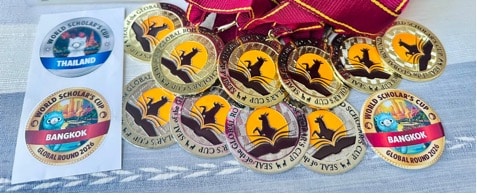
The World Scholar’s Cup is an international academic competition built around, four major events: Team Debate, where teams work together to argue a given motion; Collabowriting, where each team is given four sets of prompts to base their creative pieces on, and members have to decide together who writes which one; the Scholar’s Challenge, a 120-question-long multiple-choice test spanning the arts to the sciences; and Team Bowl, a fast-paced live quiz where teams answer together under a strict time limit. Our school has sent students to WSC for years now, and every year a large number sign up to take part. This year at the recent Global Round, the whole senior division qualified for the Tournament of Champions, and everyone came away with strings of medals, and one of us even earned a trophy for writing.
The World Scholar’s Cup encourages every team to be diligent in their studying of the extension curriculum, as well as refining their public speaking and learning to befriend people from different communities. To our surprise, we had the opportunity to socialise with students from other countries and schools at the Siam Amazing Park, with exceedingly kind tour guides. We all made plenty of friendships that day, even in seemingly competitive spaces such as the debate room. Lastly, the WSC host, Daniel, gave a moving speech on how we, as a society, should not let race be an insult – instead, race is an international celebration of identity and culture. That day, we realised one important lesson. Life wasn’t about the goal, but the progress we made – which reflects nicely on the 2026 WSC curriculum: Are We There Yet?
Collaboration shows up everywhere at WSC, sometimes in ways you don’t expect. In collabo-writing, four prompts have to be split between teammates, and you don’t always get the one you wanted, because someone else might want it too. If we all argue about it, we just waste time we don’t have, so it’s become really important to learn how to compromise fast and get on with writing. Debate leans on collaboration just as much, because if you don’t actually collaborate beforehand, you end up contradicting each other mid-round, and the whole thing falls apart because it looks uncoordinated instead of like one team. But Scholar’s Challenge is probably where it matters most, because when it comes down to picking one answer as a team, you might get it wrong, but you get through it by deciding together and moving on, not by turning around and blaming whoever’s idea it was.
In this competition, we learned an essential set of skills, cultivating our independence, confidence and understanding of the world as a whole. Initially, many would assume debate was personal, difficult and defensive. However, our experiences illustrated how this wasn’t the case at all. We were met with friendly opponents and mature, intellectual responses, which helped us boost our esteem in public speaking and affirming our positions/views. After each round, every participant is encouraged to express feedback to the opposing group. I found that this helped exceptionally, as we aren’t always aware of our own flaws.
As students, we aren’t usually obliged to interact with people we are unaccustomed with. WSC, however, pushes us out of our comfort zone and makes us do exactly that. This requires not only confidence, but also resilience and courage. For many, approaching unfamiliar people and having to collaborate with them can be intimidating, especially when they are already dealing with the immense pressure and intensity of the competition. As Mr O’Shea puts it: “For some students, it takes an awful lot of social energy for the whole competition and so requires courage and resilience in meeting new people and collaborating with them.” His understanding of these experiences comes from his own experience supporting students through Patana’s WSC ECA programme, an effort recently recognised through his achievement of Coach of the Year during the Bangkok Global Round early this September! Please send Mr O’Shea your congratulations if you see him in school!
At its very core, WSC is a holistic competition built around values that stay with students far beyond school. We are taught not only to think critically and apply what we learn, but also to communicate with confidence, collaborate with others, and have the resilience to step outside of our comfort zones. These skills are valuable far beyond the competition itself, whether we are working with classmates, meeting new people, or facing challenges in the future. WSC may be a competition, but its greatest impact is not measured by the medals we bring home (though Patana did bring home a lot!). It is measured by the people we become along the way: more open-minded, more confident, and more willing to take on challenges together, whether it be with friends or classmates. In the end, perhaps the most important thing WSC teaches us is that the journey matters just as much as the destination.