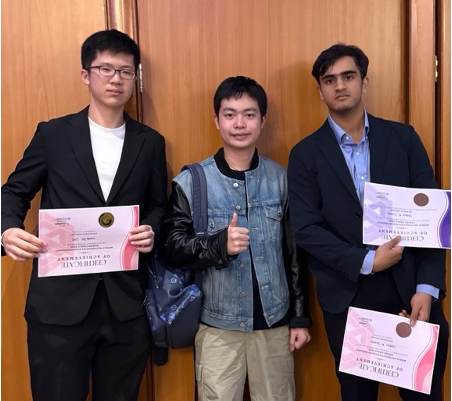
The World Mathematics Championships (WMC) senior finals 2025 was hosted in Imperial College London from 27th July to 3rd August, succeeding the WMC regional qualifiers hosted in schools across different countries, including Bangkok Patana School. Contrary to the single day qualifiers, the finals spanned across five full days of mathematics – bringing back many rounds from qualifiers and introducing new rounds breaking the expectations and boundaries of what ‘Competition Mathematics’ is about. One particular round lasted four days, where participants were grouped in randomised teams, tasked to make a fairground game and provide all the calculations of the game’s probability chances. Such week-long projects could lead to sleepless nights filled with mathematics, testing time management skills on top of the already gruelling problem solving and meticulous application of maths.
Some rounds challenged pure rigour and logic, one of which tested participants with university level proofs that were marked not only by accuracy, but also by clarity and logical order. Others required explaining how a set of written commands could be used to produce every word in the dictionary. As a result of the various unconventional rounds, students who found success were often ones who were the most creative and adaptable, not just skilled in pure maths.
As a participant myself, despite finding success in one or two rounds, I felt extremely challenged for the majority of the others, often times staring at questions with no ideas on how to begin. The competition also required my creativity, public speaking and presentation skills. These enabled me to think in many unorthodox ways to try and solve questions, leading to a comprehensive upgrade to my mathematics skill as a whole.
“Although I ran into challenges and moments of doubt along the way, I greatly appreciated the opportunity to engage deeply with two teammates I had never met before. We designed models that supported mathematical concepts, necessitating knowledge of software, hardware, mathematical foundations and the modelling process. Above all, I learned the importance of effective communication. At times, we had to compromise on sections of the project due to limitations, but each disagreement pushed us to refine our ideas and ultimately produce a more comprehensive result. I am thankful for the experience, the new connections I made, and the chance to grow, not just as an individual, but as part of a team.”– Vachivarich (Turbo) Phantratanamongkol, 13Y
“WMC was 14 hours a day, five days a week, and it felt like my head was thrust into a whole new ocean of mathematics. One moment, I was being forced to derive the very axioms of probability (with zero prior knowledge). The next, I was designing a calculator that fully integrated an offline large language model. It took everything I thought I knew about math and threw it straight out the window; if my mathematical knowledge before was like a neat stack of pages, WMC scattered them all into the air. But honestly, the highlight wasn’t the math or even seeing the same numbers from new perspectives—it was the people. The mentors, my fellow competitors and the bonds I was lucky enough to form, learn from and enjoy. WMC was a wild ride, and it redefined not just what I thought I knew about math, but what I thought I knew about learning itself.” – Dhruv Jindal 13T